Nutrition d'endurance : Quel ratio de glucides pour éviter le mur ?
Gels et boissons énergétiques : comprendre les ratios de glucides
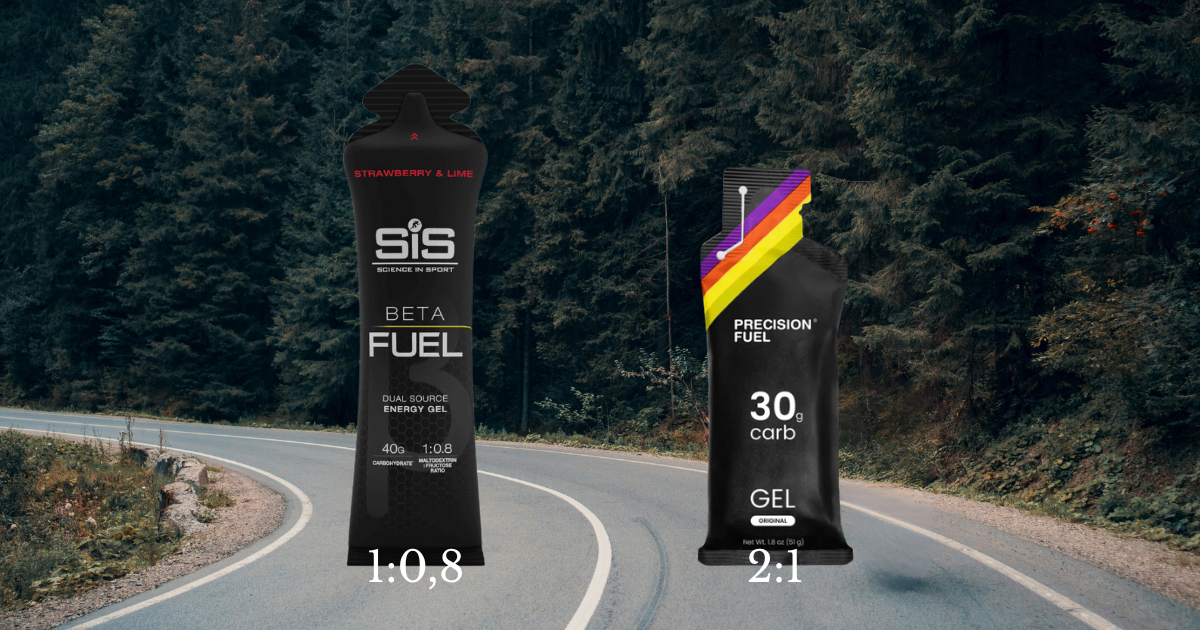
En préparant une course ou une longue sortie à vélo, on se retrouve rapidement face aux emballages de gels ou de boissons énergétiques affichant des chiffres mystérieux : 2:1 ou 1:0.8.
Loin d'être de simples arguments marketing, ces chiffres représentent la recette idéale pour alimenter vos muscles sans détruire votre estomac. Voici comment cela fonctionne, tout simplement.
1. La base : vos muscles ont besoin de sucre, mais votre intestin a ses limites
Pour continuer à avancer, vos muscles brûlent du carburant, principalement des glucides (le terme scientifique pour désigner les sucres). Les gels et boissons énergétiques apportent deux types de sucres différents : le glucose et le fructose.
Le problème ne vient pas de vos muscles, qui sont d'immenses brûleurs d'énergie, mais de votre intestin, qui doit trier et absorber ces sucres pour les envoyer dans le sang. Pour traverser la paroi intestinale, les sucres utilisent des « portes d'entrée » (appelées transporteurs) :
- La porte du glucose : Celle-ci est très rapide, mais elle a un défaut majeur. Elle sature dès que vous consommez plus de 60 grammes de glucose par heure. Si vous en prenez plus, le sucre reste bloqué dans votre intestin, crée des embouteillages et provoque des maux d'estomac, des crampes ou des nausées.
- La porte du fructose : Il s'agit d'une porte complètement différente et indépendante. Elle peut absorber environ 30 à 35 grammes de fructose par heure.
2. Qu'est-ce qu'un « ratio » de glucides ?
Le ratio indique simplement la proportion de glucose par rapport au fructose dans votre produit. Il est toujours écrit dans l'ordre suivant : Glucose : Fructose.
Le ratio 2:1 (Le standard classique)
- Ce que cela signifie : Il y a deux fois plus de glucose que de fructose (par exemple : 60g de glucose pour 30g de fructose).
- Comment ça marche : Vous remplissez la porte du glucose au maximum (60g) et vous utilisez la porte du fructose pour ajouter un petit bonus d'énergie (30g).
- Total absorbé : Environ 90 grammes de glucides par heure.
Le ratio 1:0.8 (L'évolution moderne)
- Ce que cela signifie : Les proportions sont presque égales. Il y a un peu moins de glucose et nettement plus de fructose que dans le premier ratio (par exemple : 50g de glucose pour 40g de fructose).
- Comment ça marche : Vous utilisez les deux portes de manière plus équilibrée. Le fructose est envoyé au foie, qui le transforme calmement en énergie diffuse, stabilisant la glycémie sur le très long terme.
- Total absorbé : Vous pouvez monter jusqu'à 100 à 120 grammes (ou plus) de glucides par heure.
3. En pratique : quel ratio choisir pour votre effort ?
Pour faire simple, le choix dépend avant tout de la durée de votre effort physique.
| Durée de l'effort | Quel ratio choisir ? | Pourquoi ? |
|---|---|---|
| Moins d'une heure | Peu importe | Un seul type de sucre (ou juste de l'eau) suffit ; votre corps a amplement de réserves. |
| Entre 1h30 et 3 heures | Le ratio 2:1 | C'est le meilleur compromis. Vos muscles reçoivent du glucose ultra-rapide pour l'intensité, et votre estomac digère le tout facilement. |
| Plus de 3 heures | Le ratio 1:0.8 | À force de courir ou de pédaler, l'estomac fatigue. Le ratio 1:0.8 réduit la pression sur la première porte (glucose) et fournit une énergie stable qui dure des heures. |
4. Comment fonctionnent réellement les « portes » de votre intestin
Pour bien comprendre pourquoi le ratio moderne (1:0.8) fonctionne si bien, il faut regarder de plus près la paroi de notre intestin grêle. C'est là que vivent ces fameux transporteurs intestinaux. Vous pouvez les imaginer comme des protéines navettes qui attrapent les molécules de sucre pour leur faire traverser la barrière intestinale.
Il existe deux types de navettes bien distincts :
- Le transporteur SGLT1 (La navette du glucose) : C'est un transporteur « actif ». Pour fonctionner, il doit obligatoirement se lier à des molécules de sodium (sel). C'est comme une voiture qui ne démarre que si le conducteur (le glucose) et le passager (le sel) sont à bord. Ce système est ultra-efficace, mais la file d'attente bloque strictement à 60 grammes par heure. Tout excédent garantit un embouteillage gastrique.
- Le transporteur GLUT5 (La navette du fructose) : Celui-ci fonctionne par « diffusion facilitée ». Il n'a pas besoin de sel et opère de manière indépendante. Sa capacité maximale de transport à long terme se situe autour de 30 à 36 grammes par heure.
Pourquoi le ratio 1:0.8 change la donne
Pendant longtemps, la science a pensé que dépasser 90g de glucides par heure (60g de glucose + 30g de fructose, soit le ratio 2:1) était impossible sans tomber malade.
Des études plus récentes ont montré qu'en modifiant légèrement la recette pour atteindre un ratio de 1:0.8, on soulage la pression sur la navette SGLT1 (glucose) tout en maximisant la charge sur la navette GLUT5 (fructose). Contre toute attente, cela fluidifie le passage dans l'estomac, réduit les troubles intestinaux et permet aux athlètes d'absorber jusqu'à 120g de sucre par heure pour alimenter leurs muscles fatigués !
5. Conseil de pro : l'estomac est un muscle, entraînez-le !
On ne peut pas simplement acheter un gel au ratio 1:0.8 le matin d'une course et s'attendre à avaler 100g de sucre par heure sans problème.
Tout comme vos jambes, votre système digestif a besoin d'entraînement. Si vous habituez votre corps à consommer ces mélanges de sucres lors de vos longues sorties d'entraînement, votre intestin va littéralement créer de nouvelles « portes d'entrée » (il augmente le nombre de transporteurs SGLT1 et GLUT5 disponibles). En 4 à 6 semaines, votre tolérance aux gels énergétiques le jour de la course aura doublé !
🔬 Sources et études scientifiques :
- Jeukendrup, A.E., & Moseley, L. (2010). Multiple transportable carbohydrates enhance gastric emptying and fluid delivery. Scandinavian Journal of Medicine & Science in Sports.
- Rowlands, D.S., et al. (2015). Glucose–fructose coingestion during exercise: optimal ratio for oxidation and performance. Journal of Applied Physiology.
- Viribay, A., et al. (2020). Effects of 120 g/h of carbohydrates intake during a mountain marathon. Nutrients.
- Podlogar, T., & Wallis, G.A. (2022). New Horizons in Carbohydrate Research and Application for Endurance Sports. Sports Medicine.